7% Mortgage rates are back. What Happens Next?
As of September 24, Freddie Mac reported the average 30-year fixed mortgage at 7.03%, up from 6.65% just over a month earlier.
That matters, but not in the same way for everyone.
A homeowner sitting on a 3% mortgage, a buyer trying to finance their first home, a condo owner worried about maintenance fees, a vacation-rental investor and a cash buyer are all looking at very different markets right now.
There isn’t one prediction that explains what happens next.
Here are seven things I’m watching.
We Have Short-Term Memory When It Comes to Mortgage Rates
After years of historically cheap money, 7% feels extreme.
Historically, it isn’t.
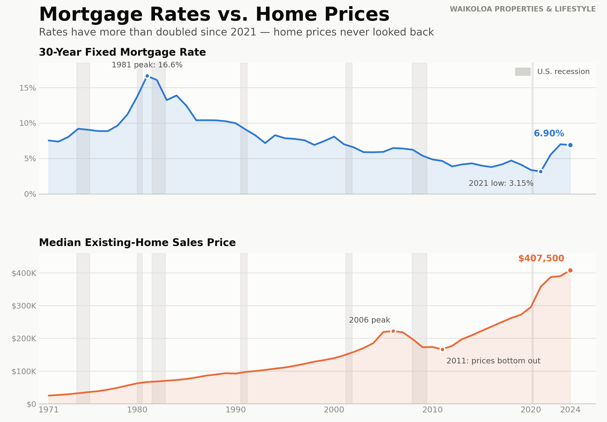
Freddie Mac has tracked the 30-year fixed mortgage since 1971. Over that period, the long-term average has been roughly 7.7%, and rates reached 18.63% in 1981.
What makes today’s market unusual isn’t simply the mortgage rate. It’s the combination of a historically normal-ish rate with home prices that were largely established during an era of exceptionally cheap money.
That combination changes the conversation.
1. Inventory Gets Stale Before It Gets Cheap
Homeowners sitting on 3% and 4% mortgages have a compelling reason to stay where they are. Selling often means giving up cheap financing and replacing it with something above 7%.
But life doesn’t stop because mortgage rates went up. People relocate, retire, get divorced, inherit property, have children and make lifestyle changes. Those situations will continue to create inventory.
My take: I don’t necessarily expect a flood of homes to hit the market. I expect more stale inventory. Homes that are positioned correctly will still sell, while properties priced for a different market can sit for months.
2. Creative Financing Saves Deals
A purchase goes beyond the contract now. The right lender, loan structure, seller credit or rate buydown can have just as much impact on whether a deal works as the purchase price itself.
My take: Creative financing and a good lender go a long way in this market. Sometimes the difference between a dead deal and a closed deal is how well the financing is structured.
3. The “Date the Rate” Crowd Is Getting Ready for a Messy Breakup
For the last few years, buyers regularly heard some version of: marry the house, date the rate.
The assumption was simple. Buy the property, tolerate the higher payment for a while, and refinance when mortgage rates come back down.
For some buyers, that temporary relationship is lasting a lot longer than expected.
My take: A future refinance should be upside, not the reason the purchase works. If the numbers only make sense at some future interest rate, the purchase probably doesn’t make sense yet.
4. Condo Owners Start Pushing Back Harder on Maintenance Fees
Condo affordability isn’t just about the mortgage.
Buyers are looking at the mortgage payment, maintenance fees, property taxes, insurance and the total monthly cost of ownership. When financing gets more expensive, an already-high maintenance fee becomes even harder to overlook.
That matters to existing owners too, especially when it’s time to sell.
My take: I expect more pressure on condo boards and associations to control costs wherever possible. Buyers don’t really care whether the extra $500 a month goes to the bank or the association. They care about the total monthly cost.
5. Vacation-Rental Math Gets Harder and Harder to Pencil
This is particularly relevant on the Kohala Coast.
Higher borrowing costs put more pressure on rental income, occupancy, nightly rates and purchase price. A property that looked like a reasonable investment with cheap financing can look very different at 7%+.
My take: I think more second homes become lifestyle assets first and investments second. Rental income can help offset the cost of ownership, but it may no longer be enough to justify the purchase by itself.
The buyer increasingly has to want the property even if the spreadsheet isn’t perfect.
6. Cash Gets Even More Powerful
Cash buyers are playing a different game.
They don’t have to solve for a 7% mortgage payment, and that becomes increasingly more valuable as financing gets more expensive and harder to qualify for.
My take: Cash buyers can afford to become more patient. If fewer financed buyers can compete, cash has more negotiating power and less reason to chase a property.
7. The Luxury Market Prevails
At the luxury end, buyers are more likely to have significant equity, larger down payments or the ability to purchase with cash. Financing costs can still matter, but they are less likely to determine whether someone can participate at all. Luxury real estate purchases become more of a lifestyle style choice than a necessity.
My take: I expect the luxury market to remain active, but increasingly selective. Buyers will still pay for exceptional properties, locations and experiences. The middle-of-the-road luxury listing will have a harder time getting away with an ambitious price.
So, What Happens From Here?
I don’t think 7% mortgage rates bring real estate to a stop, and I don’t think we should assume 7% is the ceiling either. My expectation is that rates remain elevated and could move higher before we see meaningful relief.
That forces better decisions.
Buyers become more selective. Sellers have to understand the market they’re actually selling into. Condo owners pay closer attention to carrying costs. Investors demand better numbers. Cash gains leverage. And good financing becomes a real part of the negotiation.
There will still be strong sales, good deals and buyers willing to move. But if rates continue higher, the gap between properties and buyers that can make the numbers work and those that can’t will become even more obvious.
For Waikoloa and the Kohala Coast, that’s what I’ll be watching.